
Camden council tax bands for 2026/27: band D is £2,207.12, or £220.71 a month. Every band A to H, how many Camden homes sit in each, and the discounts.
A band D home in Camden pays £2,207.12 in council tax in 2026/27. Camden’s own share is £1,696.61 and the Greater London Authority takes £510.51 on top.
That makes Camden the second most expensive of the 13 inner London billing authorities, behind Lewisham. It is £1,158.87 a year more at band D than Westminster, which starts on the other side of Euston Road. The council put its element up by 4.99%, the most it can charge without a referendum, and the GLA added 4.1%.
Camden council tax bands at a glance: band A is £1,471.41 a year and band H is £4,414.24. The most common band in the borough is D, which covers more than one Camden home in five.
The full band A to H table for 2026/27
| Band | Property value in 1991 | Camden Council | GLA precept | Total 2026/27 |
|---|---|---|---|---|
| A | Up to £40,000 | £1,131.07 | £340.34 | £1,471.41 |
| B | £40,001 to £52,000 | £1,319.59 | £397.06 | £1,716.65 |
| C | £52,001 to £68,000 | £1,508.10 | £453.79 | £1,961.89 |
| D | £68,001 to £88,000 | £1,696.61 | £510.51 | £2,207.12 |
| E | £88,001 to £120,000 | £2,073.63 | £623.96 | £2,697.59 |
| F | £120,001 to £160,000 | £2,450.66 | £737.40 | £3,188.06 |
| G | £160,001 to £320,000 | £2,827.68 | £850.85 | £3,678.53 |
| H | Over £320,000 | £3,393.22 | £1,021.02 | £4,414.24 |
Source: the council’s Guide to Camden’s Council Tax and Business Rates 2026/27. The Camden column includes the adult social care precept, which central government has required councils to merge into a single figure on the bill since 2025/26. Band values are 1991 values, not what a property is worth now.
Camden council tax by month: every band
Most people pay in ten monthly instalments, April to January, and you can ask the council to spread it over twelve instead. This is what each band works out at in 2026/27, rounded to the penny; the council may adjust the first instalment by a few pence so the year adds up.
| Band | Per year | 10 instalments | 12 instalments | Per week |
|---|---|---|---|---|
| A | £1,471.41 | £147.14 | £122.62 | £28.30 |
| B | £1,716.65 | £171.67 | £143.05 | £33.01 |
| C | £1,961.89 | £196.19 | £163.49 | £37.73 |
| D | £2,207.12 | £220.71 | £183.93 | £42.44 |
| E | £2,697.59 | £269.76 | £224.80 | £51.88 |
| F | £3,188.06 | £318.81 | £265.67 | £61.31 |
| G | £3,678.53 | £367.85 | £306.54 | £70.74 |
| H | £4,414.24 | £441.42 | £367.85 | £84.89 |
Monthly figures are before any discount. A single person on band D pays 75% of the bill, £1,655.34 a year or £165.53 over ten months.
How many Camden homes are in each band
The Valuation Office Agency counts every home on the council tax list each year. Its 2026 figures, published on 24 September 2026, put 114,360 homes on Camden’s list at 31 March 2026 (VOA, Council Tax: stock of properties 2026, table CTSOP1.1).
| Band | Camden homes | Share of Camden |
|---|---|---|
| A | 3,360 | 2.9% |
| B | 12,340 | 10.8% |
| C | 20,770 | 18.2% |
| D | 26,720 | 23.4% |
| E | 20,020 | 17.5% |
| F | 13,060 | 11.4% |
| G | 13,160 | 11.5% |
| H | 4,940 | 4.3% |
The VOA rounds each count to the nearest ten, so the bands add up to 114,370 rather than the published total.
Two things stand out. 68% of Camden homes are in band D or above, against 35% across England and Wales. And one Camden home in 23 is in band H, the top band, against fewer than one in 160 nationally. Band A, which is the most common band in England, holds under 3% of Camden’s homes. So the “average” Camden bill is well above band D, even though band D is the single most common band.
Two things sit outside the band table above. Homes in a garden square pay slightly more, to maintain the square. Long-term empty homes and second homes pay a premium, covered further down.
Where Camden sits in inner London
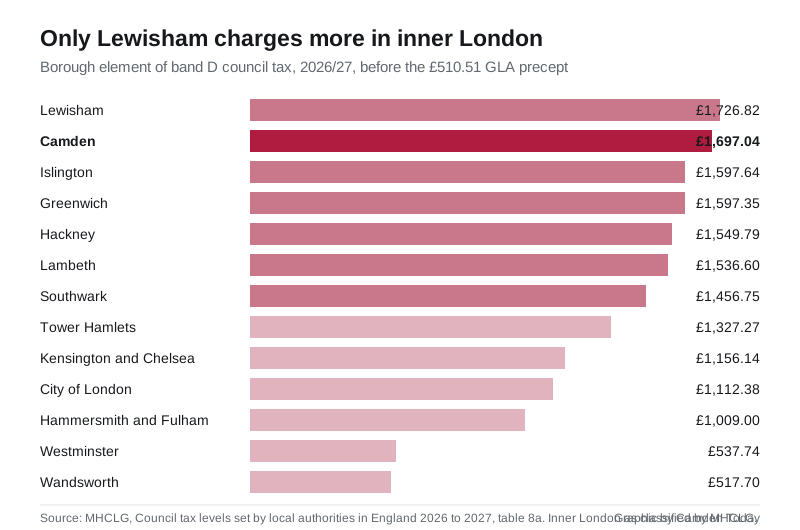
The government publishes the borough element of band D council tax for every authority in England each spring. In the 2026 to 2027 release, table 8a puts Camden second of the 13 authorities it classes as inner London, and fourteenth of all 33 London authorities.
That table records Camden’s average band D as £1,697.04, which is 43p above the £1,696.61 charge on the bill. The difference is the garden squares. Camden’s own workings show it takes £42,000 out of the sum before dividing, for services that only cover part of the borough, and the government’s average puts that money back in.
What the GLA’s £510.51 buys
Every London borough except the City pays the same GLA precept, and the GLA’s own return splits it two ways at band D:
- £334.13 to the Mayor’s Office for Policing and Crime
- £176.38 to the GLA, the London Fire and Emergency Planning Authority and Transport for London, including the Mayor’s office
Camden Council has no say over that figure and says so in its guide. The council will collect £49.77m from Camden council tax payers for the GLA this year.
How Camden gets to £1,696.61
The council’s guide shows the arithmetic, which most councils leave out:
- total cost of Camden services after income: £336.126m
- less core revenue grants: £129.929m
- less retained business rates and relief grants: £59.548m
- less the council tax collection fund surplus: £12.407m
- plus the business rates collection fund deficit: £31.196m
- leaves £165.438m to be met from council tax
- less £42,000 for garden squares, leaving £165.396m
- divided by a council tax base of 97,486 band D equivalent properties
The tax base grew by 1,717 band D equivalent properties on last year. That is why the total Camden collects rises faster than any one bill: the council tax requirement goes from £154.792m to £165.438m, up 6.9%, while the band D charge rises 4.99%.
Camden will spend over £1.1bn in total in 2026/27, of which 15% comes from residents’ council tax and 41% from government funding.
Empty homes and second homes: double, then triple
Camden charges some of the steepest empty property premiums in London, agreed at full council on 4 March 2024 and in force since 1 April 2025:
| Situation | What you pay |
|---|---|
| Empty and unfurnished, 1 to 5 years | 200% of the normal charge |
| Empty and unfurnished, 5 to 10 years | 300% |
| Empty and unfurnished, 10 years or more | 400% |
| Second home, furnished, from day one | 200% |
The premium attaches to the property, not the owner. Buy a house that has stood empty and unfurnished for a year and you pay double until you move in, let it out or it becomes a second home. At band H that is £8,828.48 a year for an empty property, and £17,656.96 once it passes ten years.
Central government sets the exceptions, and Camden lists them: armed forces accommodation, annexes, homes actively marketed for sale or let (12 months only), homes within 12 months of probate, job-related dwellings, caravan pitches and moorings, and seasonal homes that cannot legally be lived in year round. The detail is on the empty property additional charges page.
Shorter empty periods are treated more kindly. There is no council tax for one month from the date the furniture leaves, and a 25% discount for up to 12 months during major repairs or structural alterations.
Discounts worth checking
- Single person: 25% off. You apply through a Camden Account, using the reference number on your bill.
- Students: full-time students are disregarded, and an all-student household is exempt.
- Severe mental impairment, live-in carers, people in detention, care homes and hospital, under-18s, foreign diplomats and religious communities all have their own discount or exemption.
- Disability reduction: if a property has been permanently adapted, the bill is charged at the band below.
The full list is on the council’s discounts and exemptions page.
Council Tax Support: the earnings bands
Camden’s support scheme is banded on weekly earnings rather than a taper, which makes it unusually easy to check. You need savings and assets under £16,000, unless you get Pension Guarantee Credit.
If you are not working, or earn under £118.40 a week, you pay no council tax at all. Around 16,000 households in the borough pay nothing under the scheme, according to the leader’s letter in the council tax guide.
Above that, the discount depends on your household:
| Weekly earnings | No children | With children | Disabled or carer |
|---|---|---|---|
| £118.40 to £236.79 | 55% off | 65% off | 85% off |
| £236.80 to £532.79 | 35% off | 45% off | 55% off |
| £532.80 to £586.07 | none | 30% off | 45% off |
| £586.08 to £666.00 | none | 15% off | 30% off |
Earnings are gross, before tax, National Insurance and pension. Childcare costs can be deducted, up to £175 a week for one child and £300 for two or more. Anyone aged over 25 living with you who is not your partner and earns more than £110.80 a week cuts your support by 30% of the bill.
Pension age applicants are assessed on the government’s rules, with one Camden difference: war disablement, war widows and war widowers pensions are disregarded in full, rather than the £10 the government requires.
Support normally starts the Monday after you apply. Pension age claims can be backdated three months without needing a reason. Full details are on the Council Tax Support page, and the council’s number is 020 7974 4444.
How to check and challenge your Camden council tax band
Camden does not set your band. The Valuation Office Agency does, and you can look yours up by postcode on GOV.UK. Whatever you do next, you must keep paying Camden while the VOA looks at it.
What you can do depends on how long you have been paying (GOV.UK, challenge your council tax band):
| Your situation | Route | VOA decision within | Can you appeal? |
|---|---|---|---|
| Paying council tax on the home for under 6 months, or the VOA changed your band in the last 6 months | A formal proposal | Up to 4 months | Yes, to the Valuation Tribunal, normally within 3 months |
| The property was split, merged, partly turned into business use, or the area changed physically (a new main road, say) | A formal proposal | Up to 4 months | Yes |
| Paying for over 6 months, nothing has changed, you just think the band is wrong | A band review | Up to 12 months | No |
For a band review you need evidence, and the VOA is specific about what counts:
- Up to five similar homes in a lower band, in the same street or estate, matching yours on type, size, age and design. In Camden that usually means flats in the same block or a matching conversion on the same terrace, not a flat round the corner.
- Sale prices from 1 April 1989 to 31 March 1993, close to the 1991 valuation date. Asking prices and averages from Rightmove, Zoopla or the Nationwide index are not treated as strong evidence.
The VOA usually acknowledges a challenge within a few days, and can take up to 28. If it agrees, it tells Camden, which revises the bill and refunds what you overpaid. A Valuation Tribunal appeal is free, although you pay your own costs, such as an agent if you use one.
If you think the bill itself is wrong, in the wrong name, or that a discount has been refused unfairly, that is a matter for the council rather than the VOA. Camden sets out the appeal route on its right to appeal page.
Paying: instalment dates, and what a missed one costs
Camden bills in ten monthly instalments, April to January. Cash, cheque and standing order payments must reach the account by the 1st of the month. Direct Debit gives a choice of four dates: the 7th, 15th, 21st or the last day of the month. To spread the year over twelve instalments, to March, ask within seven days of getting the new bill; the council may refuse if the account is already in arrears.
The recovery steps are set out on Camden’s what happens if you don’t pay page:
- Miss an instalment and you get a reminder. Pay up, miss another, and you get a second.
- Miss a third and you lose the right to pay by instalments: a final notice makes the whole year’s bill due at once.
- Still unpaid, Camden asks the magistrates’ court for a summons, adding £80 in costs.
- At the hearing it asks for a liability order, adding £15 more. That order lets the council take the money from wages or benefits, send enforcement agents, or seek a charging order.
The council’s recovery line is 020 7974 6470. If you cannot pay, it can also consider a one-off discretionary discount, but only after you have applied for Council Tax Support and any discount you qualify for.
Frequently asked questions
How much is council tax in Camden?
For 2026/27, from £1,471.41 a year in band A to £4,414.24 in band H. Band D, the reference band, is £2,207.12: £1,696.61 for Camden Council and £510.51 for the Greater London Authority.
What is band D council tax in Camden?
£2,207.12 a year for 2026/27, or £220.71 a month over the usual ten instalments. It rose 4.99% on Camden’s share and 4.1% on the GLA’s share.
What is band F council tax in Camden?
£3,188.06 a year for 2026/27, which is £318.81 a month over ten instalments or £265.67 over twelve.
How do I find my council tax band in Camden?
Search your postcode on the Valuation Office Agency’s checker at GOV.UK. The VOA, not Camden Council, sets bands, and it is also where you challenge one.
Can I challenge my council tax band in Camden?
Yes, through the Valuation Office Agency, not the council. If you have paid on the home for less than six months you can make a formal proposal, decided within four months and appealable to the Valuation Tribunal. After that, a band review needs up to five similar homes in a lower band on your street or estate, takes up to 12 months and cannot be appealed.
When is Camden council tax taken by Direct Debit?
On the 7th, 15th, 21st or last day of the month, whichever you choose. Payments by other methods must arrive by the 1st.
Is Camden council tax higher than Westminster?
Yes, by £1,158.87 a year at band D. Westminster’s borough share is one of the lowest in England, while Camden’s is the second highest of the 13 inner London authorities, behind Lewisham.
Also on Camden Today
- Camden bin collection days: what the £2,207 buys, and what costs extra
- Parking in Camden: permit prices and the 2026 tariffs
- Camden house prices: what homes in each band actually sell for
Have your say